When choosing an LED light, some companies can make it very confusing for the average customer. Many Companies misrepresent scientific data to dazzle readers knowing that it’s irrelevant because they want to hide the truth about their products.
Many years ago as growers we were confused as well, but this is where our lighting knowledge and experience comes in. Let Spectrum King LED break it down for you - from overall performance down to the design and component level.
LED 101
Companies claim to have special LEDs with unique spectrums and unheard of performance. First, let’s talk about the spectrum wavelength and intensity ranges from industry leading LEDs. Everyone knows that white light is derived from all the colors in the spectrum chart. Let’s compare 1 watt of white to 1 watt of red or blue light. While the white LEDs are known to produce over 100 Lumens per watt, the red and blues max out at 25-45 Lumens per watt. This is simply due to their narrow spectrum and the total amount of light (strength) emitted. As a result, You CANNOT get the same intensity from a 450 Watt light using red and blue LEDs as you can from a 450 Watt light with white LEDs.
C.O.B Myth and High Wattage LEDs
 Another point of confusion for customers is the constant advertisement of a new unheard of C.O.B. (Chip On Board ) LEDs and how they will dominate the market. As a Commercial lighting manufacturer we are here to tell you that is 100% FALSE!!
C.O.B. LEDs have been around for over 10 years. There are only three reasons to choose a C.O.B. LED:
- To reduce cost of materials to make the LED
- To save companies money by eliminating the need for circuit boards
- To group more LED diodes into one small area.
Standard self contained diodes are the leading LEDs in the Industry and have performances that are double that of C.O.B. LEDs. Every LED that claims to be 10, 20, 50 or even 100 watt is a C.O.B.
DON’T BE FOOLED BY COMPANIES THAT CLAIM TO OFFER HIGH WATTAGE CHIPS!!!
Additional downsides to C.O.B. is the relatively lower efficiency and overall light output. By adding and cramming more diodes into a tight array that share the same substrate; heat becomes an issue and C.O.B. diodes run hotter and thus output less lumens, have a lower efficiency, and shorter life. 100 Watts of C.O.B. does not equal to or perform the same as a cluster of individual diodes mounted on a circuit board. Not opinion, fact.
CHIP MANUFACTURING
The Majority of Chinese made LED Grow lights are using in house assembled LED chips with standard off the shelf diodes such as Bridgelux and Epistar. Taking these diodes and making an LED on their own is highly risky for the end consumer buying the product. These companies have NO Binning and NO LM79 or LM80 Data on the LED chips. They are virtually unverified and inconsistent products. The LED making process requires a highly sterile environment and no humidity. We can tell you from previous visits to these factories in China the majority of the factories are sub-standard meaning no clean rooms, hot humid environments and no proper packaging and handling of the LEDs. Every LED batch off the production line comes out with slightly different lumens. There is a minimum and maximum range and its usually a 10% fluctuation; this is called binning. When your LED fixture has many LEDs, that 10% variance in the LEDs can equal a lot of your intensity overall. This is why we make our lights in the USA with high quality verified components.
Take a look below at some of these in house made LEDs and how they discolor and degrade over a short period of time .
LM 79 & LM 80 DATA
What is LM79 & LM80? In a brief summary “LM” is Lumen Maintenance. LM79 Is a report that shows in detail all the photometric data on a light source. Everything from total lumens, lumens per watt, CCT color temp, CRI, THD (total harmonic distortion), PF (Power Factor), spread of light and a few more parameters.
LM80 Is the Junction Temperature of the LED and the life time report. How is this done; REAL LED Chip manufactures are forced to delay product release to the market for a year. The reason this is done is to truly test the LED and make sure it does what the factories say it will. These tests must be done by third party labs that are certified by the Department of Energy.
How is the test done?
A batch of LEDs (usually 50+) is tested at the junction point of the LED at three different temperatures, usually 55, 85 and 105 Degree Celsius. The lumen output is recorded every hour for 6,000-8,000 hours (almost a year long test!) and a base line curve is made. With this data a detailed performance chart can be produced showing actual LED lumens over time. You can now determine the degradation curve and know the lumens and lifespan of a specific lighting fixture.
Many consumers buy LEDs and get very excited when they turn the fixture ON or the first time. Then after a few months they are shocked that their LED is putting out half the lumens it once did.
DON’T BE A VICTIM TO UNCERTIFIED COMPONENTS!!!
HOW LUMENS ARE LOST WITH HPS
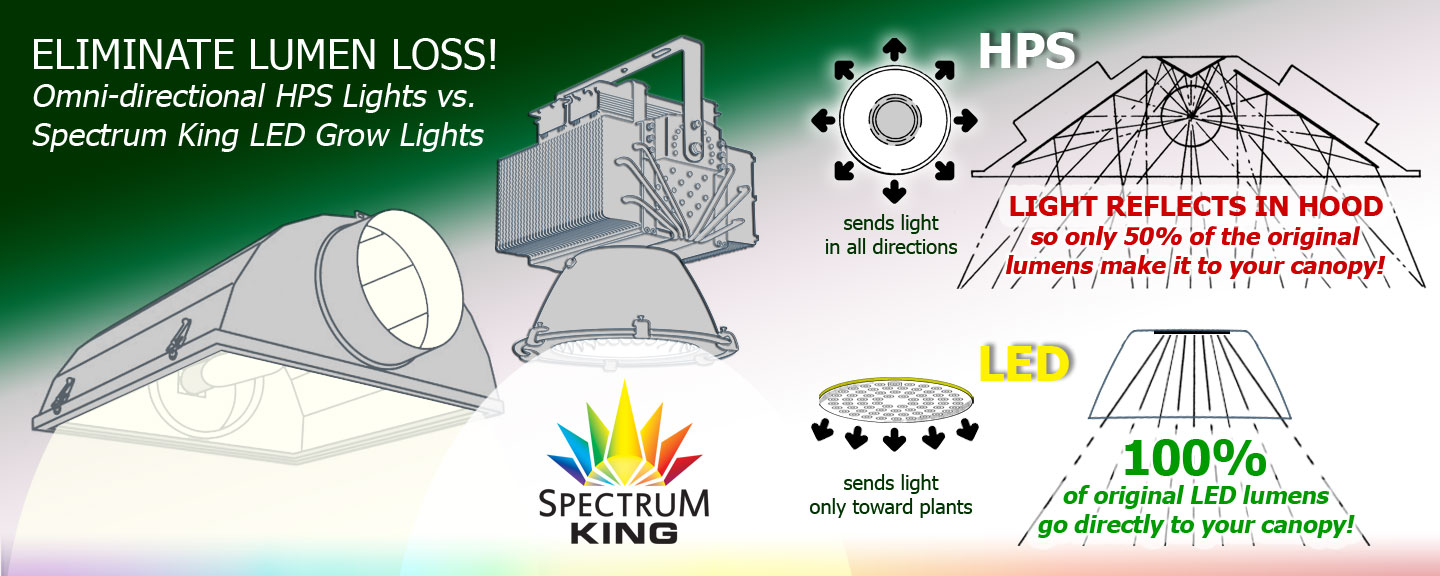 Traditional 1,000 Watt High Pressure Sodium (HPS) bulbs are known to produce 100,000-120,000 Lumens. That lumens value is typically calculated in optimal conditions using:
- a photometric sphere catching all 360 degrees of light emitted (even behind the socket!),
- state-of-the-art equipment in an environmentally controlled laboratory,
- a FRESH out of the box HPS bulb.
When you mount an HPS bulb horizontally in a reflector, it’s important to take other factors into account that directly impact the Lumens reading where it matters most, at the plant canopy. There’s Lumens loss from excess heat and the fact that light is bouncing all over the reflector, travelling farther and more indirectly to the plants below. Also, if you take into account that your plants are usually two feet away, you are really only getting ~40,000-50,000 Lumens at the canopy level - depending on the reflector and bulb type.
That’s why when you hold a meter to a Spectrum King 400 Series LED Grow Light and a 1,000 Watt HPS at the plant level, the PPFD readings match. PPFD and lumens will be relative when you measure between two sources like this. The only reason LED can achieve the same result with a much lower “Lumens” value is because it is a directed light source - same as the street lights. The Metal Halide and HPS lamps produce triple the lumens, but LEDs provide the same amount of light when measured at the street; same thing with your plant canopy and cannabis.
Spectrum is important but intensity is the #1 thing you want to check first
The issue with all the Red and Blue (Pink!) LEDs on the market today isn’t only their spectrums, it’s also their lack of intensity. Red and Blue spectrums can only achieve 25-40 Lumens per watt. So when you take 35 lumens per watt… forget that, let’s say 40… using 450 watts produces a total of only 18,000 lumens! This is the PRIME reason why all the other colored LED grow lights ultimately fail. The intensity just isn’t there. And most of the grow lights on the market are closer to 25-30 Lumens per watt, which is even worse!
WHY CREE?
Cree isn’t just another LED manufacturer. In fact they have 2500 patents and 3000 more pending. Cree is at the forefront of the technology with a relentless pursuit of quality through innovation and design to accelerate LED adoption, to push the boundaries of what’s possible with LED lighting, and to bring forth higher-performance LED’s while bringing down the cost of LED solutions. Cree is the only company with the highest performing diode material which is Silicate carbine (synthetically grown crystal). Cree’s mission is to render energy inefficient lighting obsolete and everything they do is with that mission in mind. No other LED company has done as much as Cree to develop the LED lighting market.
No other LED manufacturer is as stringent in their testing or keeps the bar as high as Cree for manufacturers who use their components in their products.
 To be allowed to say, “Powered by Cree” your product must have successfully completed Cree’s Thermal, Electrical, Mechanical, Photometric and Optical (TEMPO) testing process, in addition to the special invitation by CREE. We at Spectrum King LED are proud to say that we are one of a small handful of companies globally to have done just that.
Why is Safety Regulatory Compliance (UL and ETL, etc.) Such a Big Deal?
Let’s just say that you like peace of mind and you like to trust the things you buy to not start fires, fail miserably, shock you or cause any harm of any kind OR JUST FAIL. Would that be a set of reasonable assumptions? For most people that is exactly what they want: to buy something and have faith in it to function properly for a long time without worry.
Along comes UL! UL stands for Underwriters Laboratories which is a nonprofit safety agency created over 100 years ago. UL is recognized worldwide as a leader in product safety testing and certification. When a product is UL listed that means that every component of that product has been verified to do what it is meant to do and what it has been claimed to do by its manufacturer. None of “sure it does” or “it kind of does if…” etc. In clear black and white it has been thoroughly tested, put through an entire series of verifications and all functionality validated by an independent third party lab. No room to stretch the truth or mislead the public, just a cold hard ‘yes it passes and here is its number” or it FAILED! UL listed product can be used with confidence because they have been scrutinized down to the circuit level and have come out the other side with a number that is accepted worldwide. UL sets the standards of testing electric components and devices, period.
Unlike many of our competitors we can say that we have UL listed products. It wasn’t cheap and it wasn’t easy to get but we felt and still feel that when we provide our customers with a product we want them to know that they will get years of worry free usage from that product and nothing guarantees that better than being UL approved.
What is IP65 and Why Should I Care?
A very good question indeed! IP65 rated products can be used in wet or humid environments (grow rooms and greenhouses fall squarely into those categories) and they will not fail or cause any dangerous issues. Sounds simple enough doesn’t it? Well think about this for a minute then realize that few CURRENTLY AVAILABLE horticultural fixtures other than ours sold in any quantity are rated safe for use in wet or humid environments. That’s right! In reality the bulk of lighting fixtures and bulbs sold today are not approved for the very place they are marketed to work in!
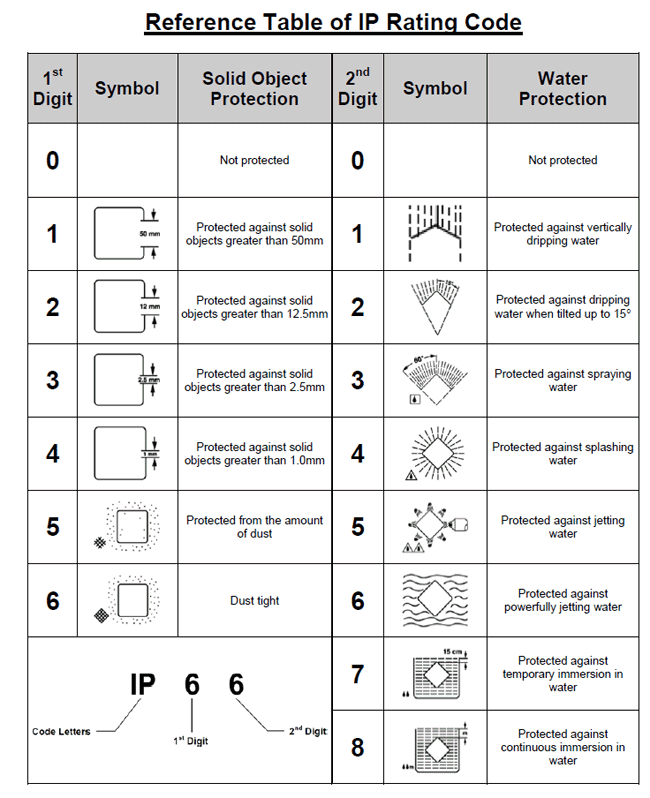
As more rules and regulations come into indoor gardening and places of business are inspected many insurance companies will NOT give them a policy to protect their business and investment because they are essentially involved in a high risk operation by using electrical devices not meant to be in wet or humid environments. You want peace of mind in your grow operation? You want to be able to know that if something does go wrong you will not lose your whole investment or cause major damage to your facility by a failing light fixture. That’s what the IP65 rating is! The guarantee that a product has been verified safe for wet or humid environments. You can turn our lights on in the shower with no risk of shock or harm! Let any other horticultural lamp manufacturer say that with a straight face and no fingers crossed behind their backs.